Cool Drawings of Eyes Easy
Before you beginning drawing
Iii quick things you need to practice before we get to cartoon:
-
Choose a reference photo

Here is the reference picture I'll be using. I chose this one because the centre in it is wide open and y'all tin can see the entire iris which makes explaining some steps easier. If you want, you tin can choose your own photo and follow my directions.
-
Use the grid (if you choose to use it)
I divided my movie into smaller parts in Photoshop. You can do the same in MS Paint. Or check out a free app that'll do that for you lot – download one from here.
If y'all're adding the grid to your ain photo, don't use also many lines. We don't want the moving picture to be unreadable. If you have issues with the sketch later, cut a problematic square with an additional line.

If you're drawing with me, open this epitome in a new tab so you're able to return to it whenever you need without scrolling back to this part.
-
Collect all the necessary tools
Here is a list of tools I used:
- Good quality paper
If you're here to do, feel free to employ your sketchbook. If y'all're creating a legitimate cartoon I recommend working with better quality newspaper. I use Strathmore Bristol Smooth paper for most of my drawings. It's very popular amongst pencil artists. And affordable!
- 4B and 6B pencil
My favorite pencils are Faber Castell Goldfaber 1221. What I like about them the most is that I have around l of them and not a single one ever bankrupt. I keep dropping them, they keep keeping their leads in 😉
- Mechanical pencil with a 2B atomic number 82
That's the one I use most frequently. I could create a whole drawing with information technology, but I think it'southward smarter to apply softer pencils mentioned higher up for shading. And then we'll use a mechanical pencil for details.
- Blending stumps
For blending, of class.
- Makeup brush
Some other tool I use to blend. It works wonders with bright shades, where the stump could cause too much smudging. I use a makeup brush instead of a paintbrush considering information technology'southward softer.
- Kneaded eraser
The most important affair in every pencil creative person'south toolset. Utilise it for erasing, shading, highlighting, you proper name information technology. This eraser can be molded into any shape. It picks graphite off the newspaper, in layers, without leaving any mess. I recommend getting a couple of those, as y'all'll apply them oftentimes and they'll get muddy pretty quick.
- Pen or pencil eraser
I have both. Pencil eraser for its convenience and pen eraser for the finest lines.
Now, to the actual tutorial!
How to draw eyes step by step
-
Sketch a simple heart outline
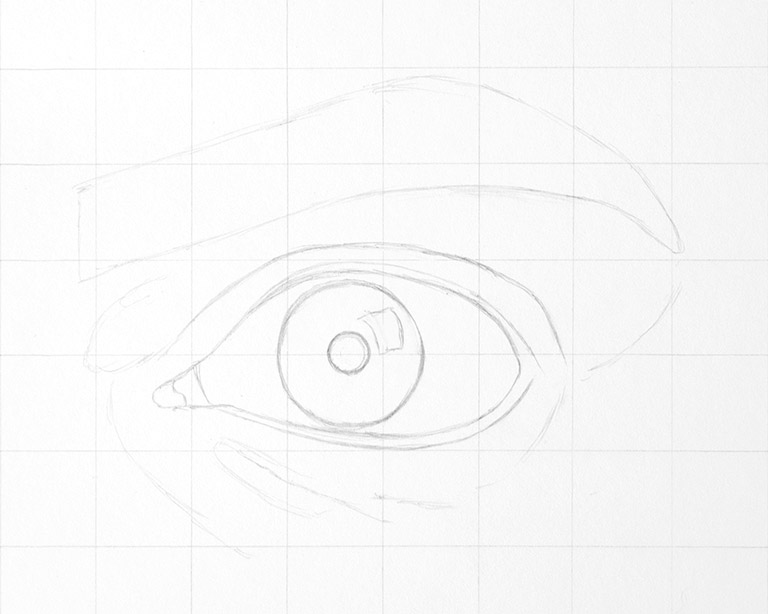
Sketch out all the basic shapes. Then, with lighter strokes, marker the outline of more prominent shadows you lot're able to notice at this point.
I started with the educatee and continued adding shapes around it.
How to sketch eyes using grid – proper gild
- Educatee
- Iris
- Light reflection
- General centre outline
- Inner corner elements
- Crease
- Waterlines (eyelid rims)
- More prominent shadows and wrinkles
- Eyebrow
- Line connecting the outer corner with the brow
Hover your mouse over the picture or tap it to see the numbers.
Think that the pupil and the iris should be circles. Exist sure to look at them from a slightly different angle and run into if they're more than or less circular. Another thing to accept in mind is that the pupil should be right in the center of the iris.
Now, with every eye comes a spot of reflected calorie-free. The shape of information technology is defined by the light source, like a lamp or a window (in our example it's a window). It'south common to detect multiple highlights in your model's eye. I usually choose to ignore them – 1 bigger spot is plenty – it makes the eye pop and keeps the drawing clean. You'll attain the best results if the reflection cuts into the pupil, so information technology's half there and half on the iris.
Every bit far as waterlines are concerned, keep in mind that they get thinner closer to the inner eye corner. Visibility of the upper waterline depends on the bending from which we wait at the heart.
Last but not least: be careful with lines that span beyond multiple squares. Later you've fatigued the contour in each square, await at the whole line once again and polish it out.

Pro tip: When drawing using a grid, always retrieve to check what that grid has made yous do. Draw in particular squares separately to ensure good proportions. Then look at the whole film and bank check if the shapes look decent, if they connect smoothly and whether or not yous need to move things around a little.
-
Fill the student
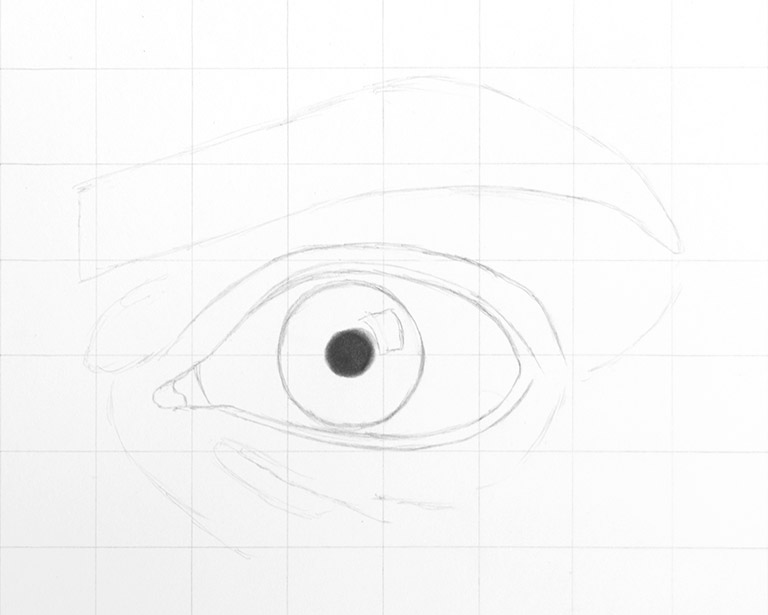
Commencement, you may want to gyre your kneaded eraser on the drawing a couple of times to make the sketch less visible. I left it equally is so yous can see it meliorate.
The darkness of the pupil will define the dissimilarity of our drawing. Fill it in properly, using a soft pencil (at to the lowest degree 4B). Add layers until you reach a shade the closest to black.
If the highlight on your middle spills onto the pupil, keep that area white! It will be incommunicable to erase it afterwards without any graphite remainder showing.
-
Accentuate the iris

In the side by side couple of steps, I'yard going to show you how to depict an iris.
Kickoff, fill up in the whole iris. Tilt your pencil slightly to go on the strokes soft, like on the correct side of the picture beneath.

Exit the calorie-free reflection white. It's the second cistron defining the contrast. Make it the brightest element of your eye drawing.
Using a much darker shade, define an outline of the iris. Make that line pretty thick.
If you're drawing a different middle, in which the lids embrace some part of the iris, get out that part unfilled.
-
Blend the iris

Before whatsoever blending, brand sure that y'all've erased gridlines around the iris. We need that area to be clean because nosotros'll not only alloy the inside, just as well the outer edge of the iris. If nosotros don't erase these lines, they'll stay visible and trying to erase them after will destroy our perfect blend.
Utilize a blending stump to smoothen the inside of the iris. I like to alloy in the opposite direction to that of the pencil strokes. The truth is I usually end up blending all over the place, then don't call up of it every bit a rule.
The last footstep here is smudging that dark circle on the outside of the iris we've made earlier. Use the tip of a stump to do that, keeping it slightly tilted.
Pro tip: Using your stumps' tips is the quickest way to ruin them. Still, I practice ain that ane stump that's already had enough and I can damage it a trivial scrap more. Then should yous.
Get-go, dilute the dark circle towards the pupil. Then, smooth out the outer border. If you lot look at whatever centre, y'all'll notice that the border between the iris and the sclera is soft rather than sharp.
-
Make full the iris with some basic lines
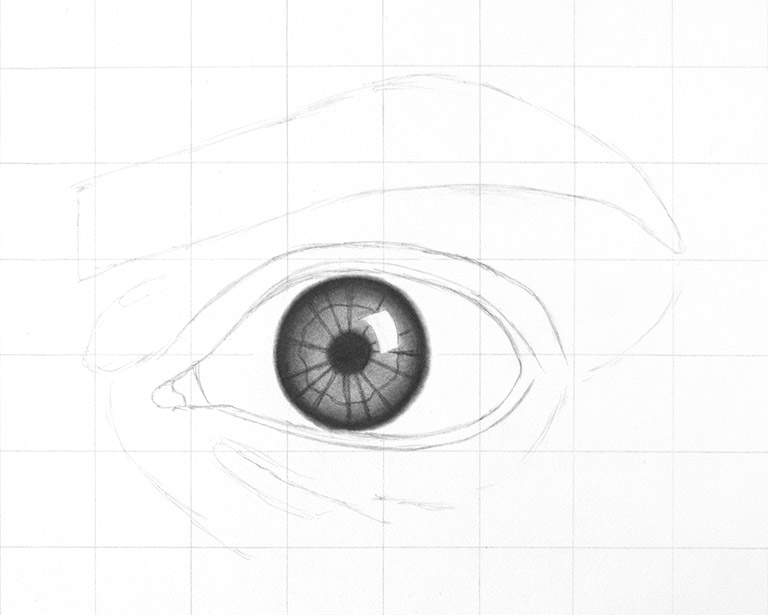
If your goal is to create a hyperrealistic eye drawing, the next 4 steps are crucial – nosotros'll draw a detailed iris.
If you lot feel similar it's besides much, that's okay. Fifty-fifty without these details, your drawing volition look impressive. All these odds and sods may also exist redundant if you're creating a portrait or a whole person sketch, where you won't exist able to see such tiny details anyway. If so, feel costless to skip to stride number 9.
Otherwise, draw a wiggly circumvolve around the pupil. This ring usually separates different colors, shades or structures in the iris.
Adjacent, add a couple of straight lines around the pupil. They should kickoff right in the center of the pupil and finish at the iris edge (hover over the image). Make sure the distance between them is irregular – the whole iris is quite a mess and nosotros want to make it as disordered as possible.
Pro tip: Utilize a pencil that'due south a bit worn out so the lines have some thickness.
-
Add dark spots and more lines

Condense the lines: toss in some shorter ones – beginning or ending at the wiggly inner circle.
Add together a few double lines that look like orange vesicles (or teardrops). You can fill them in or non.
Finally, make full in a couple of areas created past the net of lines.
(Hover over the epitome to see what I mean)
-
Erase vivid spots

Look at the reference picture and examine the iris construction over again.
Tin you lot encounter all the brighter parts? We're going to rub them out. How cool is that? It'south my favorite part of a cartoon process – really cartoon with an eraser.
Pro tip: Use an eraser in the form of a pencil, or an eraser pen, to rub out little details precisely.
As yous can come across, I erased a office of a wiggly ring, as well equally some lines and larger areas. A lot of them, actually. Do whatever y'all want hither. I insist. Accept some fun. It's actually satisfying to permit get while erasing!
-
Add together even more detail

It'southward fourth dimension to have some fun again.
Add more "orange vesicles", black or white. Erase some more lines. This time brand them even whiter. Feel gratuitous to connect a couple of lines and so they create piddling veiny structures.
Fix the contrast and add together more than depth by concealment some areas.
Cease with erasing the large white light reflection properly, making sure information technology'southward clean and has sharp edges (it has to be the whitest part of the eye drawing)
-
Fill in the darker half of the sclera

Adept news – we're back to simpler things!The iris parts the center in the middle. I of the halves is unremarkably darker than the other, depending on the direction of light.
I like to depict whatsoever's on the left commencement considering I'1000 right-handed and I don't want to smudge my drawing. That's why nosotros're starting with the darker, left part – it's not some important rule established by Da Vinci, no.
Tilt the pencil and make full in the sclera.
The calorie-free source is on the right, so the left corner will apparently exist darker.
-
Blend it and refine the dark edges

Take your stump and blend what you've just fatigued. Brainstorm with the brighter parts and continue towards the dark corner. This manner you avoid dragging graphite residue to the areas that don't need it.
Proceed in listen that you're currently shading a ball. Think of how the shadows and lights conduct on round objects. If you find it hard to imagine, I highly recommend reading this commodity on how to shade. It'll help y'all empathize how light behaves.
Don't forget to refine the outline of the centre, where the lids cast a small shadow on the eyeball. Blend it too, especially the lower one. The upper one is not a big bargain at this moment – afterwards we'll be covering it with more shadow.
-
Draw the middle corner elements

This is an easy footstep – but draw what you meet in your picture. Usually, the centre corner is only a triangle, sometimes information technology'due south divided into two chunks.
Blend it and add some white spots with an eraser, so that it looks wet.
-
Fill in the second half of the sclera
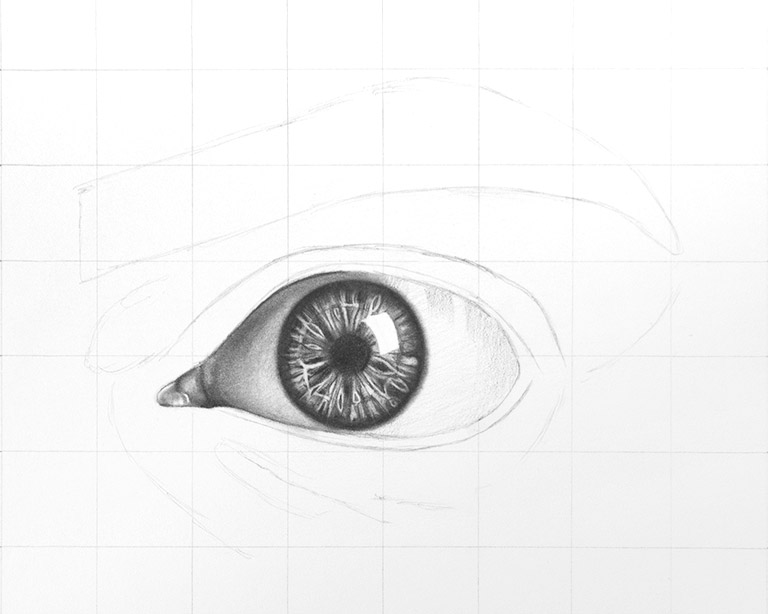
Fill this function with light force per unit area. Add together a scrap more shadow in the corner (ball shading!).
As you can come across in our moving picture, lashes can cast shadows on the eyeball. Include them in your centre cartoon past throwing in a few darker lines with a worn out pencil.
Start them at the upper edge of the eye outline. Make their length irregular, so the shadow looks realistic. Remembering the three-dimensional shape of the eye, curve these strokes slightly in line with the roundness of the eyeball (hover your mouse over the image)
-
Alloy it with a make clean stump

Blend what you've merely drawn with a clean stump. Exercise not use the one you smudged the darker part with!
The cast shadows should be blended in the same manner as they were drawn – with strokes starting at the upper chapeau. Make sure to lower the force per unit area on a stump as you go away from the lid, so the transition from a shadow to a white-ish sclera is smooth.
-
Right the outline

Draw a nighttime line separating the upper lid from the eyeball connecting it with the one we've fabricated in stride 10.
And so, do the same at the lesser hat but with a lighter tone – there's more light reaching this office of the eye.
Utilize an eraser to pause that lesser line with some white, simply like I did. The heart is wet and it usually reflects some low-cal at that place.
-
Correct the contrast in the eye
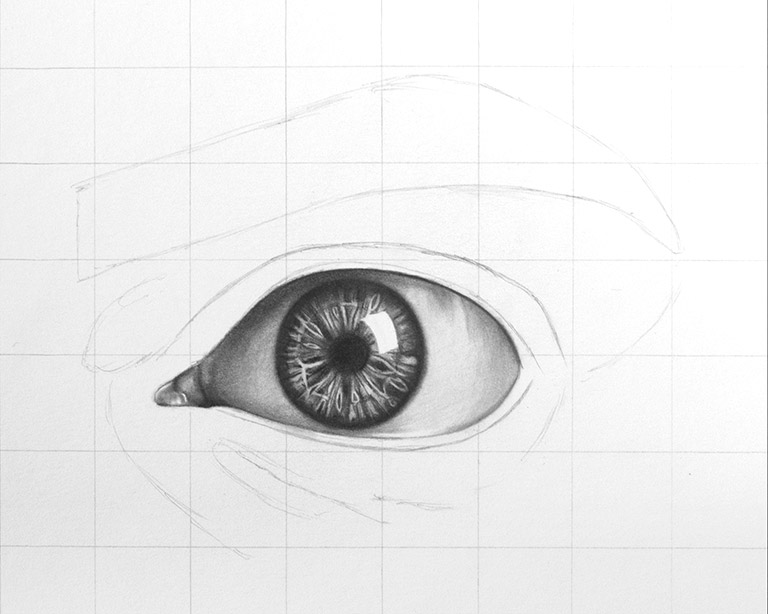
Last step before we proceed to depict the eyelids:
Look at your picture from a distance and see if it needs any fixes. Add more than shadows/highlights where y'all think the drawing could use more contrast.
I made the shadows on the left side more prominent to increase depth on my drawing. I also added a shadow below the upper chapeau. If you hover over the image, you should see a photo from stride 14 overlaying the current progress – use that to see the changes I applied.
-
Shade eyelid rims
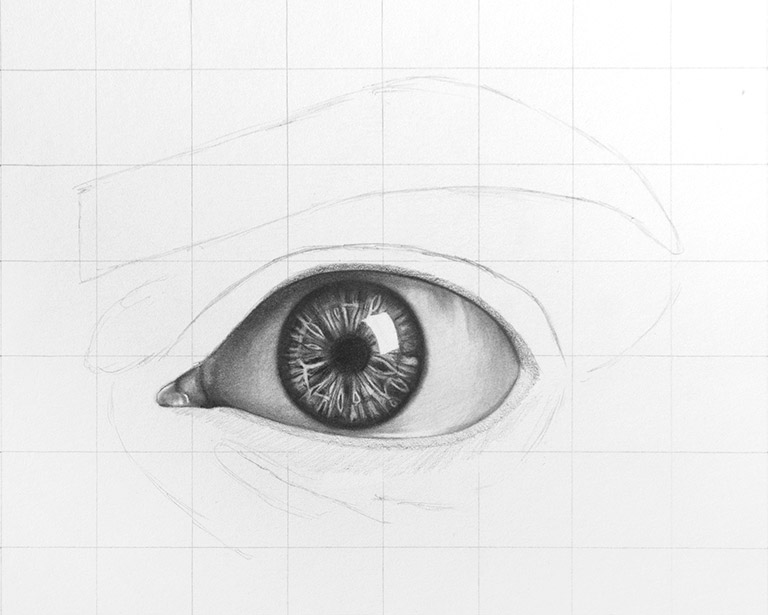
Allow'south begin with erasing the outer line on the lower rim near completely with a kneaded eraser. Leaving it visible is the number i mistake in realistic centre drawing. After y'all've done that make full it with a light shade.
Adjacent, fill up the upper rim with a darker tone than the lower one. The transition betwixt both shades in the outer corner isn't very smooth – every bit soon as the low-cal hits the lower hat it becomes brighter than the upper one.
You tin probably run into that I likewise added some delicate strokes below the lower rim.
Pro tip: Earlier I blend a edge between two shades, I similar to have both of them fatigued – adding the 2nd shade later may issue in some strokes going outside that edge and ruining the already smooth area of the shade number one.
-
Blend the rims

Polish out both lines, starting with a brighter one. Add some tone variation on the lower rim, similar a bit of reflection in the outer corner.
-
Shade the upper lid and a brow ridge

Outset stride hither – erase the gridlines that cover the upper chapeau area. I didn't and you lot tin see them showing from under the graphite layer. Information technology's usually possible to blend them with the rest of the image, but sometimes they exercise stay visible. So don't follow my example here. Erase the hell out of them.
Next, refine the crease line – brand it really nighttime and rather thick.
Fill the whole area the way I did. Beginning in the inner corner and stop at the line connecting the crease with the forehead. Remember to clothing out and tilt your pencil for that.
Looking at our reference photograph y'all'll come across that y'all should brand the left side a bit darker. Aforementioned with the surface area above the crease-brow line. Follow my sketch along with the shadows yous can see in the original picture.
Let's also begin shading the pucker. You should add a gradual nighttime shade below the pucker on the left and above it on the right. Look at the motion-picture show to see where the switch really happens.
-
Blend the area above the center

Blend everything with a stump and a brush if yous have one.
Pro tip: Using a soft brush (preferably a makeup brush) can help you achieve better results than a blending stump, especially with vivid shades.
Cross the eyebrow line a bit, so that in the next steps you're able to shine the transition between these areas.
-
Refine shadows and highlights

Only look at your cartoon and determine whether it needs more contrast. I drew more than shadows in the pucker expanse (added one under the crease on the right side and darkened the rest of them)
I besides used my kneaded eraser to create a highlight on elevation of the forehead ridge.
-
Shade the space between the eye and the olfactory organ

But like in step nineteen, permit's erase the gridlines kickoff.
Then, comprehend the whole surface area evenly.
Add some other layer to darken the shadow next to the base of the nose.
-
Connect it with the upper lid

This is the first part that actually contains the edge of our eye drawing. While blending information technology, don't forget to fade it out properly to the left side.
Another matter to retrieve is to cross the eyebrow outline again.
Connect this office of the skin with the one we've drawn previously so the shading is even throughout the whole upper lid.
-
Add layers below the eye

Over again, erase unnecessary gridlines.
Add a few dots on the lower rim line, so that you can yet see where information technology should be, even subsequently you blend the lower lid surface area. Don't worry almost their visibility – we'll grow eyelashes out of them subsequently!
Fill the remaining skin with gentle strokes. Go along calculation layers in the areas that demand more shade. Play with some cross-hatching here o ensure improve coverage – change the direction of strokes in each layer past 90 degrees.
-
Alloy the lower lid

Blend everything. As always, begin with lighter tones.
I used a brush to blend the fair peel at the bottom of the drawing and stumps for all the darker shades.
-
Add more depth

Per usual, expect at your middle drawing and see if you should raise the contrast, aka darken the shadows.
You can also describe a couple of wrinkles in this footstep. Use gentle strokes to make the finest of lines.
-
Smooth everything out

If yous've added new layers, use a stump to blend them into the rest of the drawing.
Transitions between shades of the skin should be subtle and soft, so caress them with your brush. Take that aforementioned brush – at present you lot accept some graphite residue on it – and blend out the edges of your drawing.
-
Innovate skin texture with highlights

This is some other step you can skip if y'all're creating a less realistic slice. If and so, leap to step xxx.
Meet all those tiny wrinkles in the eye corner? Information technology's drawing with eraser fourth dimension again!
I used my eraser pen for that – information technology'due south super thin and does a groovy task with lines.
Showtime, draw some lines and spots in the eye corner, so move to the pare on the lower lid.
This texture may wait complicated, only I created information technology by simply stroking the surface area in i management outset, and calculation some random lines after (preferably in the opposite direction). The goal is to create a pattern that kinda looks like peel cells – a net of tiny lozenges and triangles.
While I had the eraser in my hand, I too added some highlights around the waterline and on the eyeball.
-
Add a pop of dissimilarity
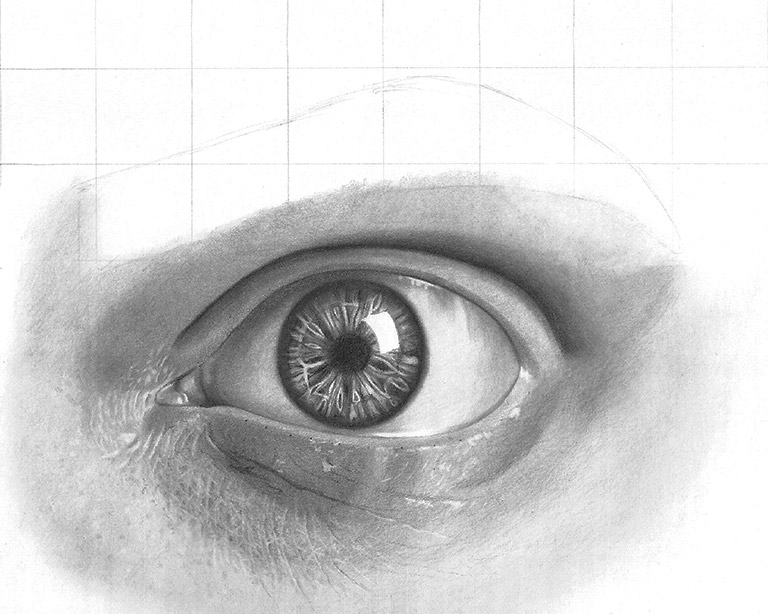
Because that all the wrinkles and texture are indentations in the skin, y'all should pair each highlight with a shadow. Practice it with a worn out pencil or with a tip of a blending stump.
The light source is on the upper right, so all the notches should take a shadow on top or on the correct.
I overlayed this moving-picture show with the one from the previous stride to aid y'all see the changes I applied.
-
Add together veins

While we're at the details, let's add some veins on the eyeball.
Draw a few irregular lines varying in shade. They accept to be actually thin, then use a rather sharp pencil. But don't push button it too hard. We want them to be subtle so they don't overshadow the iris. Information technology's an centre drawing, not a cardiovascular organization cartoon, wink, wink.
-
Fill the brow

Erase the rest of the grid.
Shade the forehead (tilt the pencil, cantankerous-hatch)
Next, fill the eyebrow with hairs. We'll blend them next, so yous don't have to be precise yet. Sharp pencil, assuming strokes. To see the direction of the hairs better hover over the image.
If you're using a different reference film where the forehead is brighter, you may desire to make your strokes softer. Even a subtle change in the shape or color of the brow can alter the face entirely.
-
Blend for (almost) the last fourth dimension

Blend the skin on the forehead first. Every bit you tin run across, I was a little too sloppy with my cross-hatching, and now the strokes are pretty visible. Feel free to do a meliorate job than I did 🙂 I managed to fix it subsequently with a castor simply why get to so much trouble.
Side by side, blend the countenance so that it'southward smooth but still has some texture. That's a play a trick on I use to create enough thickness without having to describe every unmarried pilus.
If you're drawing a thinner or brighter eyebrow, your blending should be more gentle than the 1 I did on my middle drawing.
-
Draw eyebrow pilus
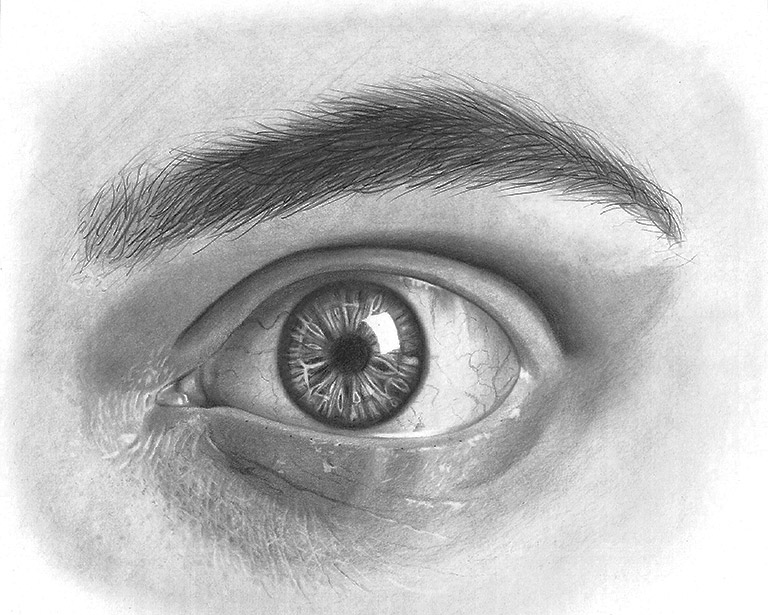
Now we're going to have more fun with the hair.
Start with the left side of the forehead. Notice that these hairs grow almost upwards. They plow to the side above the inner corner of the center. At the stop they plow downwards where they besides become shorter than the ones we drew in the middle.
-
Sculpt the brow bone

By sculpting I mean… adding more shadows, yes! Above the countenance, too every bit beneath it. To exercise that, I dabbed my brush in a patch of graphite residue I made on some other piece of paper and transferred information technology onto my drawing.
Per usual, hover your mouse over the prototype to meet the changes I applied.
You should be able to see that I also added a subtle layer of graphite on the pare texture/wrinkles under the eye to make them softer.
-
Add lashes
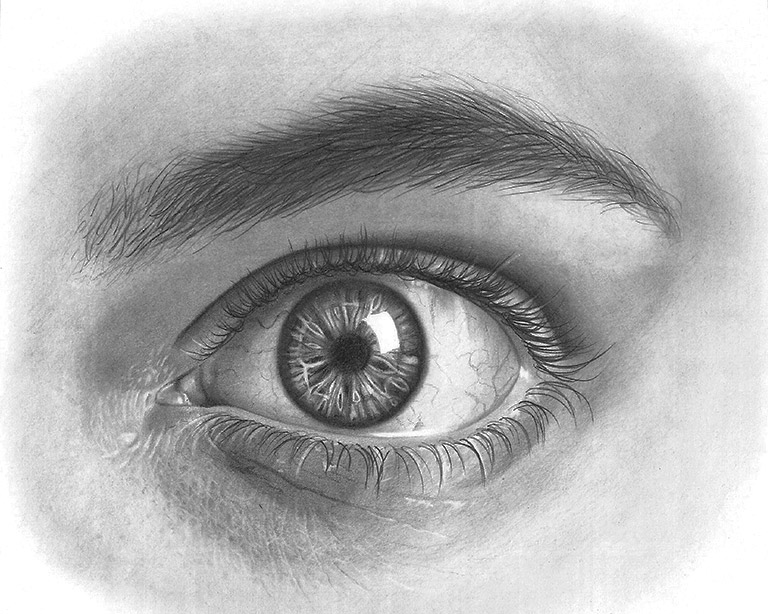
Where you start is crucial to the eyelashes drawing process. They should always grow from the outer line of the lid rim, never from the middle of it!
Look at how the shape of the lashes changes on the middle outline. You lot may want to expect at this eyelashes drawing tutorial to empathize that part of an centre cartoon meliorate.
Placing them irregularly is a key to draw realistic eyelashes.
Don't forget to add together a couple of reflections – use a pen eraser to add some white strokes in the lashes.
-
Utilise more skin texture

Source: https://luizacreates.com/blog/eye-drawing/
0 Response to "Cool Drawings of Eyes Easy"
Enviar um comentário